
When people shop for a hot tub, they naturally compare the things they can see, such as the number of seats, jet placement, shell color, size, and price. But there is another important question worth asking before you buy: How easy will this hot tub be to maintain once it is in your backyard? Every hot tub requires routine care, including testing and treating the water, cleaning or replacing filters, and periodically cleaning the spa itself.
The design of the hot tub can make those tasks easier—or make them feel more complicated than they need to be. Filtration, equipment access, water-care features, controls, and even the shape of the shell can all influence what day-to-day ownership feels like. If easy maintenance is important to you, there are several features worth looking at before choosing a spa.
Start With the Filtration System
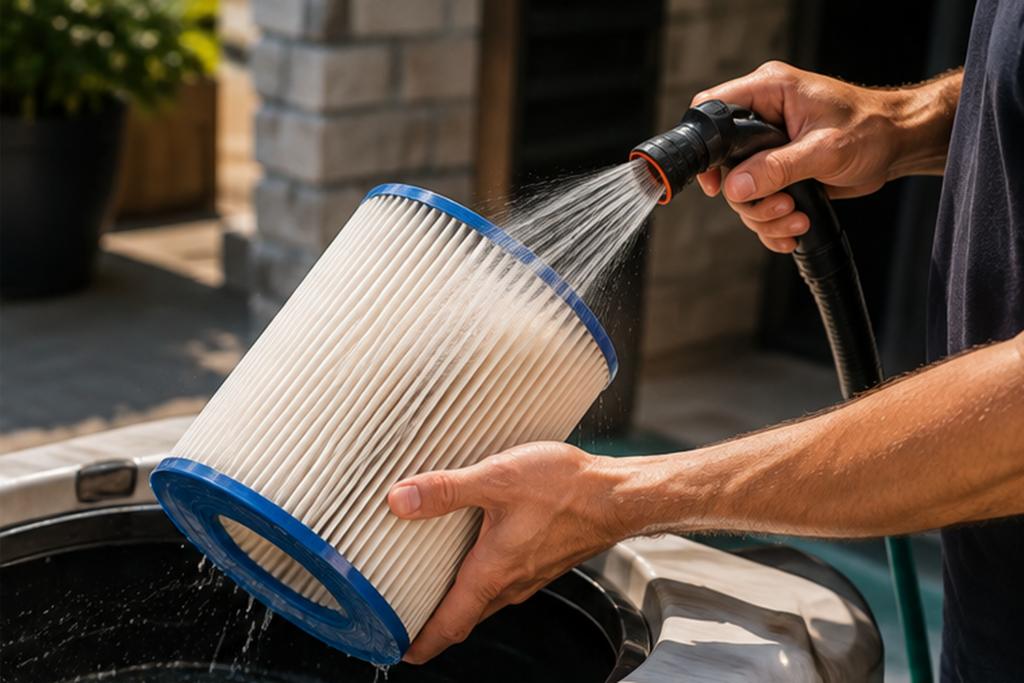
A hot tub’s filtration system is one of the most important parts of keeping the water clean. As water circulates through the spa, the filter captures particles and debris before the water returns to the hot tub. Because the filter needs to be removed, rinsed, cleaned, and eventually replaced according to the manufacturer’s recommendations, filter access matters. If you have to struggle to reach or remove the filter every time it needs attention, a simple maintenance task can quickly become frustrating.
When comparing hot tubs, ask the dealer where the filter is located and watch how it is removed. The Centers for Disease Control and Prevention (CDC) recommends easy access to mechanical and filtration components so routine and preventive maintenance can be performed more easily.
More Filtration Is Not the Only Thing That Matters
You may see hot tubs advertised with different filter sizes, multiple filters, or various filtration technologies. While those specifications can be useful when comparing models, bigger numbers do not automatically mean a hot tub will be easier to maintain. The filtration system still needs to work effectively with the spa’s water volume, circulation system, and overall design, and the filter itself will still require regular cleaning and replacement as part of routine hot tub care. A large or sophisticated filter does not eliminate the need for regular cleaning, and a dirty filter can restrict water flow regardless of how impressive the filtration system looked on the sales sheet.
Rather than comparing filter size alone, ask the dealer these questions while you shop:
- How often does the manufacturer recommend cleaning it?
- How easy is it to remove?
- How many filters does the spa use?
- What does a replacement filter cost?
- Are replacements readily available?
Those questions can tell you more about long-term ownership than filter size by itself.
Water-Care Systems Can Reduce Some of the Work
Some hot tubs offer supplemental water-care systems such as ozone or UV. These systems are designed to work alongside the spa’s regular sanitizer and filtration system rather than replace them. For example, Love’s offers Artesian Spas with water-care options that include ozone-based systems. Depending on the system and how the spa is used, these features may help support water clarity and reduce some of the burden placed on the primary sanitizer. When comparing options, ask the dealer how the system works and what maintenance it still requires.
It is also important to remember that supplemental water-care systems do not make a hot tub chemical-free or maintenance-free.
The CDC still recommends maintaining appropriate disinfectant levels and pH in hot tub water. For residential hot tubs, its guidance recommends a pH between 7.0 and 7.8 and at least 3 ppm chlorine when chlorine is used. So when you see a hot tub advertised as having an advanced water-care system, ask what that feature actually does and what ongoing water care will still be needed.

Look at How Easy the Equipment Is to Reach
Eventually, almost every hot tub will need some type of inspection, adjustment, or service. Pumps, heaters, control systems, plumbing connections, and other components are generally located behind the spa cabinet, so how easily those components can be reached matters. If service access is difficult, even a relatively simple repair or inspection can become more complicated.
The CDC’s hot tub design guidance recommends providing easy access to mechanical and filtration components for routine and preventive maintenance and service. That same principle makes sense for a residential hot tub. Before buying, look at the equipment compartment and ask the dealer how easily the main components can be accessed if maintenance or repairs are needed.
Ask:
- How is the cabinet opened?
- Which panels need to be removed?
- Can the main equipment be reached without dismantling a large portion of the spa?
- Is there enough room around the components for service?
You may rarely need to access the equipment yourself, but easier access can make diagnosis and service simpler when maintenance is eventually required.
Can the Hot Tub Be Completely Drained?
Hot tub water is not meant to stay in the spa forever. At intervals recommended for your particular spa and water-care routine, the water needs to be drained and replaced, which makes drainage another small design detail worth considering. The CDC’s hot tub guidance recommends basin designs that can be easily, quickly, and completely drained and refilled and that allow the surfaces to be regularly scrubbed and cleaned.
When shopping, ask the dealer where the drain is located and how the draining process works. A drain that is easy to access can make periodic water changes simpler, less frustrating, and easier to manage as part of your regular hot tub maintenance routine.
Shell Design Can Affect Cleaning
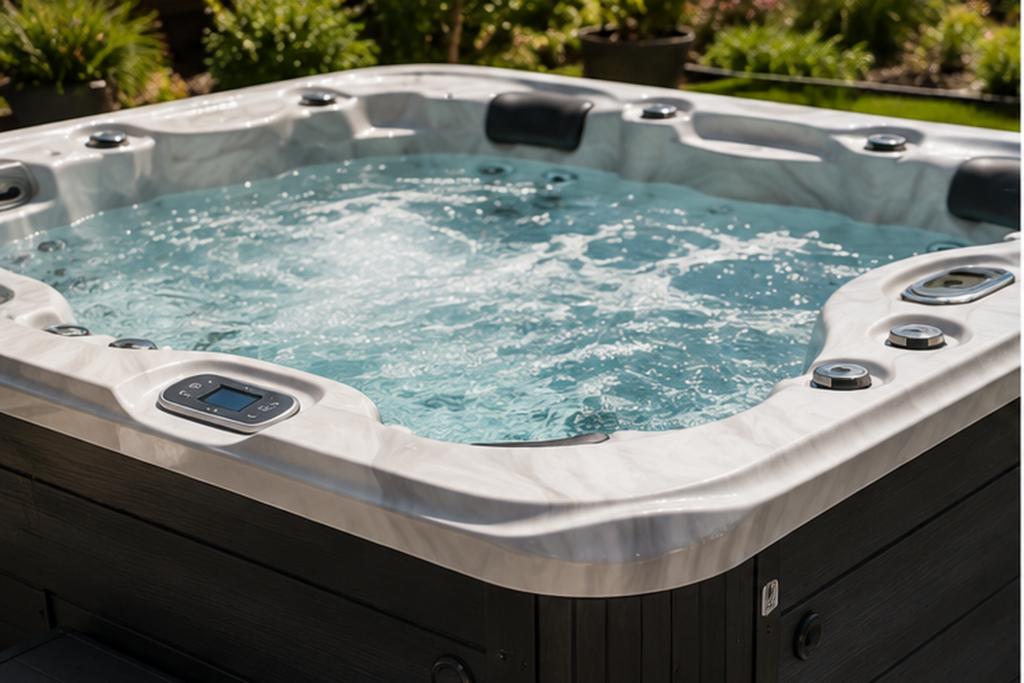
Take a close look inside the hot tub, too. Seats, footwells, waterlines, jet openings, and other surfaces all need occasional cleaning. A highly sculpted shell with numerous contours can create more areas where debris may collect than a simpler interior. That does not make one design better than another—comfortable seating and hydrotherapy may be worth the additional detail—but it is something to consider if minimizing cleaning time is a priority.
The CDC recommends that hot tub basins be designed so they can be regularly scrubbed and cleaned. When you sit in a showroom spa, do not just ask whether the seats are comfortable. Also look at the shell, footwell, and other surfaces and consider how easy they appear to be to wipe down and maintain over time.
Controls Can Make Routine Care Simpler
Modern hot tub controls do more than simply change the water temperature. Depending on the spa, the control system may let you manage filtration cycles, heating modes, jets, lighting, and other settings that affect how the hot tub operates day to day.
A complicated control panel does not necessarily mean the hot tub is more capable, and a simple control system does not automatically mean it has fewer useful features. What matters most is whether you understand how to use the controls and can easily adjust the settings you will rely on during regular hot tub ownership.
Before purchasing a spa, ask the dealer to show you:
- How to change the temperature
- How filtration cycles are controlled
- Whether filtration settings can be adjusted
- How different pump or circulation modes work
- What alerts or error messages look like
A system you understand is much easier to manage than one you have to look up every time you need to make an adjustment.
A Good Cover Reduces What Gets Into the Water
The cover also plays an important role in routine maintenance. When the hot tub is not being used, a properly fitted cover helps keep leaves, dust, insects, and other debris from entering the water. Less debris in the spa means less material for the filtration system to capture and less cleaning for the owner. The cover itself also needs routine care, so it is worth considering its condition, fit, weight, and overall ease of use.
A cover lifter can make it easier to remove and replace the cover consistently instead of leaving the spa uncovered because the cover is difficult to handle. At Love’s Hot Tubs, the cover and cover lifter are included with a new hot tub purchase as part of the all-inclusive package, which gives owners two important maintenance-related accessories from the start.
Do Not Confuse “Easy Maintenance” With “No Maintenance”
This is one of the most important things to understand before buying any spa: there is no truly maintenance-free hot tub. Hot water, people, lotions, body oils, debris, and the outdoor environment can all affect water quality. The CDC recommends routinely checking hot tub disinfectant and pH levels because maintaining proper water chemistry is an important part of controlling germs.
Filters still need to be cleaned, water still needs to be tested, and the spa still needs to be drained and cleaned periodically. The goal of a well-designed hot tub is not to eliminate maintenance completely, but to make those necessary tasks simpler, more convenient, and easier to manage.
Questions to Ask Before Buying
Maintenance should be one of your priorities; ask these questions while you are shopping:
- Where is the filter located?
- How easy is the filter to remove and clean?
- How often will the filter need to be replaced?
- Does the spa have ozone, UV, or another supplemental water-care system?
- What does that system actually do?
- What water-care tasks will I still need to perform?
- Where is the drain located?
- How does the spa drain?
- Can the shell be easily wiped and cleaned?
- How do I access the pumps, heater, and other equipment?
- How complicated are the controls?
- What routine maintenance does the manufacturer recommend?
- Are replacement filters and common parts readily available?
Take a few minutes to ask these questions before you buy so you can get a much clearer idea of what owning the hot tub will actually be like and how easy it will be to maintain.
Choose a Hot Tub You Will Enjoy Owning
The best hot tub is not only one you enjoy sitting in. It should also be one you feel comfortable taking care of.
The best hot tub is not only one you enjoy sitting in. It should also be one you feel comfortable taking care of over time. Accessible filters, thoughtful circulation, helpful water-care systems, easy-to-reach equipment, straightforward controls, and a practical drain and cleaning design can all make routine ownership easier.
At Love’s Hot Tubs, you can compare hot tubs from Artesian Spas and Nordic Hot Tubs and look beyond the seats and jets to the features that can affect long-term maintenance. Before choosing your spa, ask how it feels, how it fits your space, and how easy it will be to care for once you bring it home.