
When shopping for a hot tub, horsepower is one of those specifications that sounds easy to compare. A spa with a 3-horsepower pump may seem like it should automatically outperform one with a 2-horsepower pump, but that is not necessarily the case. Horsepower tells you something about the motor, but it does not tell you everything about how the hot tub will actually perform.
Water still has to move through the pump, plumbing, valves, fittings, and jets before it reaches you, so a bigger horsepower number does not automatically translate into a better massage. To understand hot tub performance, it is better to look at the entire water-delivery system rather than focusing on one number alone.
What Does Horsepower Measure?
Horsepower is a measurement of power, and in a hot tub, the electric motor drives the pump that moves water through the plumbing and toward the jets. That makes horsepower an important specification, but it is still only one part of a much larger water-delivery system.
Pump manufacturer Waterway Plastics describes spa-pump performance using factors such as intake size, water flow, and head pressure in addition to motor design. Those details help show why two pumps with different horsepower ratings cannot be accurately compared by looking only at the number printed on the motor.
Water Flow Is What You Actually Feel
When you sit in a hot tub, you do not feel horsepower—you feel moving water. The pump has to pull water in, move it through the plumbing, and push it through the jets. How much water ultimately reaches those jets depends on the design of the complete system, including plumbing size, bends and fittings, valves, the number and type of jets, pump design, and other restrictions that can affect water flow.
Waterway’s Viper spa pump, for example, is designed as a high-volume pump and uses a large wet end and intake to support flow performance. That is a good example of why pump performance involves much more than horsepower alone and why the overall water-delivery system matters when comparing hot tubs.
What Is Head Pressure?
You may occasionally encounter the term head pressure when reading about pumps. In simple terms, head pressure refers to the resistance a pump must overcome as it moves water through the system. Every length of pipe, turn, fitting, valve, and jet creates some resistance, which means the same pump may deliver a different flow rate depending on how restrictive the plumbing system is.
Waterway’s pump specifications refer to both flow performance and head pressure, which helps show why the pump and plumbing system need to be considered together. You do not need to calculate head pressure while shopping for a hot tub. The important takeaway is that the pump does not operate in isolation, and overall system design plays a major role in how the spa performs.
More Horsepower Does Not Automatically Mean Stronger Jets
Imagine putting a larger motor on a system with restrictive plumbing. The motor may have more power, but the amount of water that ultimately reaches each jet is still affected by everything between the pump and the jet opening. Now compare that with a spa that uses a well-matched pump, efficient plumbing, and a thoughtfully designed jet layout. Even with a lower horsepower rating, that system may still provide excellent jet performance.
That is why shoppers should avoid treating horsepower like a score where the biggest number automatically wins. The entire hydraulic system matters, including how the pump, plumbing, valves, fittings, and jets work together. Horsepower is worth considering, but it should always be viewed in the context of the complete system.
Jet Count Matters Too
Horsepower becomes even harder to evaluate when you consider how many jets the pump is supplying. A 3-horsepower pump powering 20 jets is doing a different job than a similar pump supplying 40 or 50 jets, and the size and type of those jets matter as well. Some jets are designed to move a broader volume of water, while others create a more focused stream or rotating massage.
That is why comparing only pump horsepower—or only jet count—can be misleading. A better approach is to look at how the pump, plumbing, and jets are matched as a complete system and whether that system delivers the type of massage and water movement you actually want.
Look at Real Hot Tub Examples
The hot tubs Love’s carries provide a good example of how manufacturers match different pump systems to different spa designs. The Nordic Crown All-In-110V is a six-person spa with 15 jets and a 1-horsepower continuous-duty pump, while the Nordic Warrior XL Classic uses a 2-horsepower, two-speed pump. Other Nordic Sport Edition models use 3-horsepower pumps with larger or different jet configurations.
Those differences do not mean the 3-horsepower spa is automatically the better choice. Instead, they show how manufacturers engineer each hot tub around a specific combination of spa size, jet configuration, electrical requirements, and intended performance. The pump needs to make sense for the overall design, not simply have the largest horsepower number.
Continuous-Duty Horsepower Is Worth Understanding
Another term shoppers may encounter is continuous-duty horsepower. The way horsepower is described can vary across pump and motor products, which can make headline numbers difficult to compare unless you understand how those ratings were determined. Waterway has described some of its spa pumps using continuous-rated horsepower, which is another reason buyers should be cautious about assuming every horsepower number is measured or presented in exactly the same way.
Rather than getting too focused on the terminology, ask the dealer how the spa actually performs with its specific pump, plumbing, and jet configuration. The more useful comparison is how the complete system works together and whether it provides the type of water movement and massage experience you want.
Pump Size Should Match the Spa
A properly designed hot tub needs enough pump capacity to serve its intended jet system, but bigger is not always better. An appropriately sized system balances several factors, including:
- Pump capacity
- Plumbing diameter
- Number of jets
- Jet size and style
- Water flow
- Electrical requirements
- Noise
- Energy use
- Equipment longevity
The goal is not simply to install the largest motor possible. The goal is to build a system in which all of those pieces work together effectively and deliver the right balance.
What About Two Pumps?
Larger spas may use two pumps rather than relying on one larger pump to supply every jet. This allows manufacturers to divide the hot tub into different jet zones or distribute the workload between separate systems. As a result, a dual-pump spa may have a very different hydraulic design from a one-pump model, even when the total horsepower appears similar.
This is another reason horsepower should not be considered by itself. If you are comparing these types of spas, ask which seats and jets each pump serves, how the workload is divided, and whether different jet zones can operate at the same time. Those answers can tell you much more about how the spa will actually perform than the horsepower numbers alone.
Does Higher Horsepower Mean Higher Energy Costs?
Not automatically. Energy use depends on more than the horsepower number on the pump. Pump run time, pump speed, filtration schedules, insulation, heater operation, water temperature, outdoor conditions, and overall spa design can all affect electricity consumption. A larger pump running for a shorter period and a smaller pump operating for longer periods can create very different energy-use patterns.
That is why horsepower alone cannot tell you how much a spa will cost to operate. The Pool & Hot Tub Alliance’s portable-spa energy-efficiency standards evaluate the spa as a complete unit rather than using pump horsepower as a stand-alone measure of efficiency. That is a much better way to think about operating costs and overall energy performance.
Bigger Numbers Can Be Useful Marketing—But Ask What They Mean
Hot tubs come with plenty of numbers:
- 50 jets.
- 3 horsepower.
- 400 gallons.
- Seven seats
Numbers are easy to compare, which makes them useful when shopping. But they can also oversimplify the decision because the largest number in each category does not automatically produce the best hot tub.
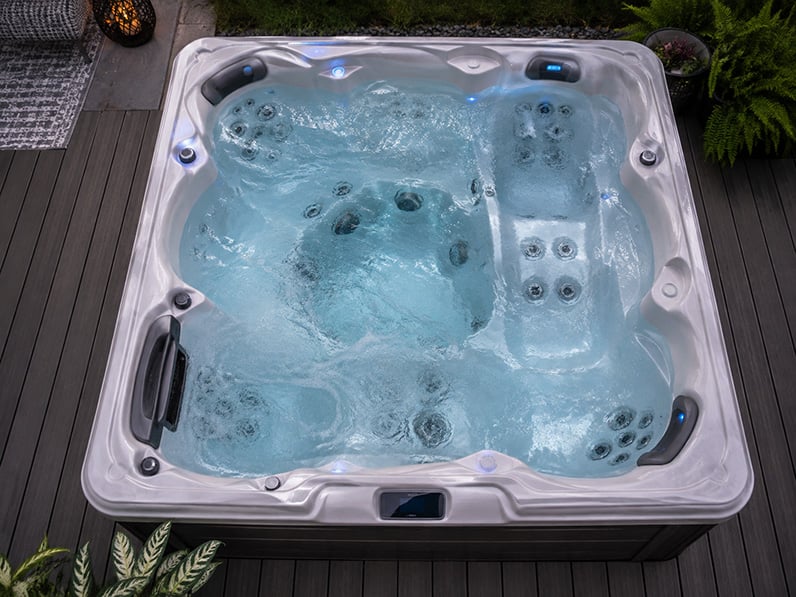
A spa with fewer well-positioned jets may feel better to you than one with dozens of jets. A smaller hot tub may fit your household better than the largest model, and a properly matched pump system may provide exactly the water pressure you want without having the largest horsepower number on the showroom floor.
Questions to Ask About Hot Tub Horsepower
When comparing pumps and hot tubs, ask:
- What is the pump’s horsepower rating?
- Is it a single-speed or two-speed pump?
- How many pumps does the spa use?
- How many jets does each pump supply?
- Can all jet zones operate at the same time?
- Can water flow be redirected between seats?
- How does the spa feel when several people use the jets at once?
- Is there a separate circulation pump?
- How does the complete spa perform in energy-efficiency testing?
- How is the pump matched to the plumbing and jet system?
Those answers provide much more useful information than horsepower alone because they help you compare how the spa actually performs rather than relying on a single specification.
Buy the Experience, Not the Biggest Number
Horsepower matters, but it should not make the decision for you. The pump needs to work with the hot tub’s plumbing, jets, seating layout, and overall hydraulic design, and a larger motor cannot tell you by itself whether the spa will provide the massage experience you prefer. At Love’s Hot Tubs, you can compare hot tubs with different pump sizes, jet configurations, and seating designs rather than choosing a model based on a single specification.
Ask about horsepower, but also sit in the spa, look at the jet arrangement, understand how the water is distributed, and consider how you actually plan to use the hot tub. When it comes to performance, the best system is not necessarily the one with the biggest number—it is the one whose components work well together.